Y Ddraig Goch (The Red Dragon) became the official flag of Wales in 1959, although a dragon has represented the Principality since 830.
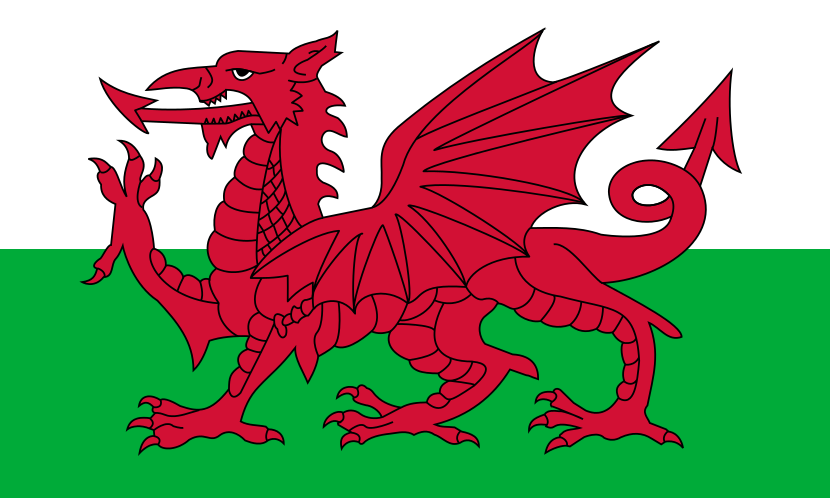
We can date the symbol of the Red Dragon to the Roman occupation of Britain, or to Arthurian Legend.
Merlin prophesied a battle between a red dragon (the Britons) and a white dragon (the invading Saxons).
The Scots adopted the dragon as a royal standard in 1138, and Richard I used it as a standard during the Third Crusade in 1191.
Four other English kings have used it during battles: Henry III at Lewes (1264), Edward III at Crécy (1346), Henry V at Agincourt (1415) and Henry Tudor (later Henry VII) during his invasion of England and at Bosworth Field (1485).
After Bosworth Field, Henry Tudor added his family colours (green and white) to his Red Dragon flag.
 Unlike the other home nations, the primary flag of Wales does not use the cross of its patron saint.
England uses St George’s Cross; Scotland, St Andrew’s Cross; and Ireland, St Patrick’s Cross.
The flag of St David is a yellow cross on a black background, and features in St David’s Day celebrations on 1 March.
Bonus fact: Dragons also appear on several other flags: Bhutan, Malta GC, Qing Dynasty China, Cardiff, Ljubljana and Puerto Madryn.
Author: Alex Crouch, Flag Institute accredited journalist (2015/16).