The Flag Institute recommends the following specification for the Union Flag, the world’s only national flag that has no basis in law.
For guidance on the rules to follow when flying this flag, see UK Flag Protocol.
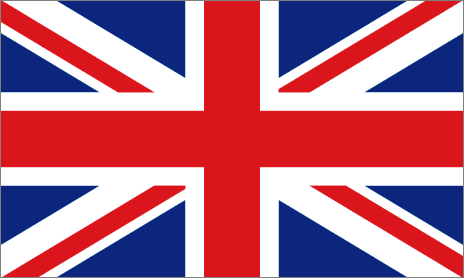
1. The Union Flag comprises three crosses on a royal blue background: a red St George’s cross, a white St Andrew’s saltire and a red St Patrick’s saltire.
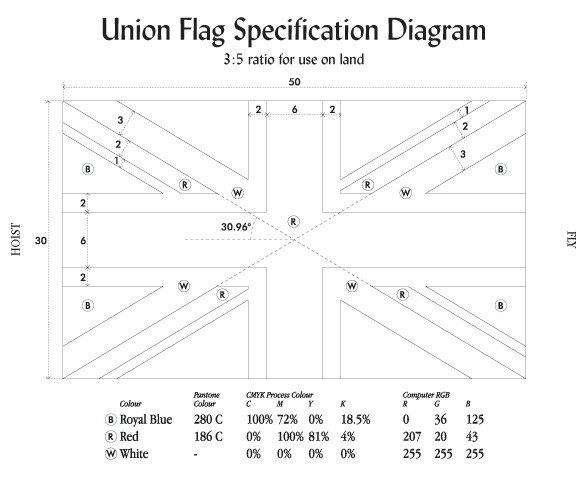
2. The proportions of the flag are 30 units wide by 50 units long
3. Each diagonal is in total 6 units wide, comprising white (3 units), red (2 units), white (1 unit):
- the broader white diagonal is uppermost at the hoist (i.e. nearest the flagpole)
- the narrower white diagonal is uppermost at the fly (i.e. furthest from the flagpole)
4. These two 6-unit-wide diagonals run from corner to corner:
- the centre line of each intersects opposite corners of the flag
- these two centre lines intersect in the centre of the flag
5. A 6-unit-wide red cross runs from edge to edge, centred on the flag
6. This red cross has a 2-unit-wide white fimbriation (or border).
7. The flag should fly with the broader white diagonal on the side nearest the flagpole uppermost.
8. The recommended colours are: Pantone 280 C (royal blue); Pantone 186 C (red); no specification (white).
Diagram
- the normal proportions for use on land are 3:5
- the customary proportions of ensigns for use at sea are 1:2
- the specification for the 1:2 version replaces the length of 50 with 60
- the specification for the 1:2 version replaces the angle of 30.96º degrees with 26.57º.
Union Flag Bill (2008)
The Flag Institute has tried without success to give the Union Flag a basis in law, most recently in the Union Flag Bill (2008).
The bill was introduced under the Ten-Minute Rule on 5 February 2008 but failed to progress beyond its first reading.