On 27 February 1990 Latvia re-adopted the flag used after declaring independence from Russia on 18 November 1918.
But the story behind it dates back over 700 years.
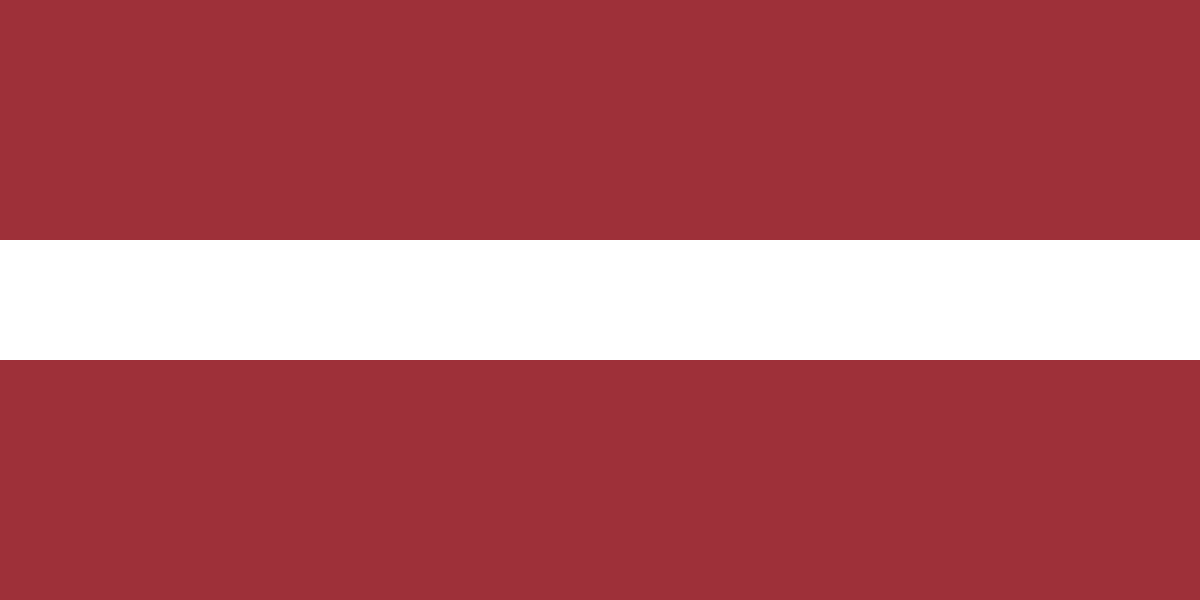 According to legend, the body of a Latvian clan leader was wrapped in a white sheet.
The strip where he lay remained white but his blood stained the rest of the sheet red.
During their next battle his clan fought under this very sheet and won.
A similar story also surrounds the origins of Austria’s flag.
The Livonian Rhymed Chronicle mentions a battle in 1279 or 1280, when Latgalian soldiers from Cēsis (a town around 50 miles north-east of Riga) fought under a red flag with a white stripe.
In 1922, four years after independence, Latvia adopted its horizontal tricolour of carmine-white-carmine (Ansis Cīrulis’ adaptation), and it remained the national flag until Soviet annexation in 1940.
Under Soviet occupation the Latvian SSR used two flags.
The first, used from 1940–53, was based on the flag of the USSR, substituting the letters ‘L.P.S.R.’ in gold above the hammer and sickle.
The second (1953–90) replaced the letters with a hollow gold five-pointed star.
It also featured rippling water in blue and white at the base.
It is now illegal in Latvia to display this flag, or anything showing the hammer and sickle, in public.
Bonus facts: Carmine is a deep red, ‘very slightly’ purplish in tone. It is sometimes used to symbolise the readiness of Latvians to shed their blood to defend their nation.
Author: Alex Crouch, Flag Institute accredited journalist (2015/16).