Union Jack or Union Flag? What do you call the UK’s national flag?
Vexillologists know that either name is valid.
Union Jack or Union Flag? An Official Flag Institute Guide gives a full explanation.
Or read on for a handy summary.
Union Jack or Union Flag? A brief history
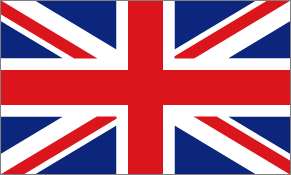
In 1606 King James VI and I ordered that, from their main masthead, all English and Scottish ships – warships and merchant vessels – should fly the flag of his new realm of Great Britain.
This flag was described initially as the ‘British flag’ or ‘flag of Britain’.
The term ‘Union’ first appears in 1625, but what of ‘jack’?
‘Jack’ can have a diminutive meaning and as such was used to describe a small flag then flown by ships from a flagstaff rigged on the bowsprit.
By 1627 it appears that a small version of the Union Flag – described thereafter as the ‘Jack’, ‘Jack flag’ or ‘King’s Jack’ – commonly flew in this position.
And by 1674 the Admiralty acknowledged two names: the formal ‘His Majesty’s Jack’ and the informal ‘Union Jack’.
Over the following century staysails replaced the bowsprit flagstaff and the Ensign became main distinguishing flag of the Royal Navy.
Naval vessels began to fly the ‘Union Jack’ only when in harbour and from a specially rigged ‘jackstaff’ in the bows.
So the term ‘jack’ predates the ‘jackstaff’ by over 150 years.
Nor is ‘Union Jack’ a name specific to a Union Flag flown in the bows of a warship.
From the 17th century onwards, the Admiralty employed both names interchangeably, irrespective of use.
In 1902 an Admiralty Circular pronounced either name officially valid.
And in 1908 Parliament approved this verdict, confirming that ‘The Union Jack should be regarded as the National flag’.
Cdr Bruce Nicolls OBE RN (Retd)