Canada’s iconic Maple Leaf flag was officially unveiled on 15 February 1965 on Parliament Hill, Ottawa.
Queen Elizabeth II had proclaimed it as the new flag of Canada just over two weeks earlier.

Its designers were George Stanley and Col. John Matheson.
George Stanley was Dean of the Arts at the Royal Military College of Canada (RMC).
John Matheson was an MCP, representing Leeds, Ontario.
A plaque at the RMC, and Matheson himself, suggest that inspiration struck Stanley when viewing the RMC flag:
I particularly recall standing beside George Stanley and looking up at the Royal Military College flag flapping furiously from the Mackenzie Building, one of the college’s buildings in Kingston.
This flag had three vertical pales, red-white-red, with the college crest (a mailed fist holding three maple leaves) on the white centre pale.
We had just emerged from the college mess and Dr Stanley remarked ‘There, John, is your flag.’
Interpreting him literally I remarked that Canadians would not accept a mailed fist symbol.
He said, ‘No, I mean with a red maple leaf in the place of the college crest.’
History of the maple leaf
The maple leaf was a no-brainer.
It has been a symbol of Canada since the 1700s.
It has also formed part of the Ontario and Quebec coats of arms since 1868, the year the Red Ensign became Canada’s unofficial flag.
A year earlier, Alexander Muir composed The Maple Leaf Forever, which in 1980 lost out to O Canada as the official national anthem.
By 1921 the maple leaf had made its way onto Canada’s coat of arms, coins, and the headstones of its war dead.
 The choice of red and white was designed to keep Quebec within the union.
Nevertheless the province held an independence referendum in 1995 which was even closer than last year’s Scottish equivalent.
(The Quebec ‘No’ campaign won by just 54,288 votes).
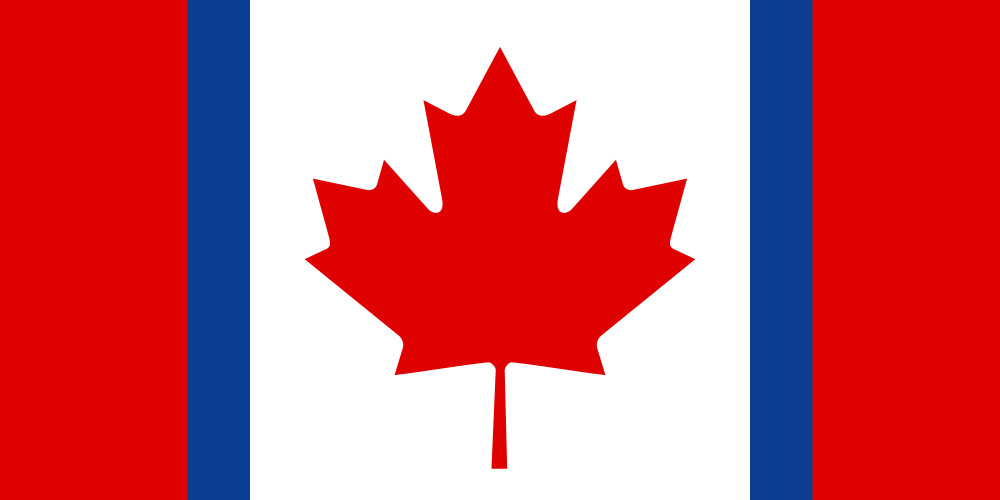
That winning campaign used a Maple Leaf flag with blue pales inserted between the leaf and red pales.
Today it is Canada’s unofficial Duality Flag, representing Francophones and Anglophones.
As part of the 50th anniversary celebrations of the national flag in 2015, Canada has released a special, C$5, fabric stamp – their first-ever stamp of its kind.
 Bonus facts: French-Canadians refer to the flag as l’Unifolié (the one-leafed).
An early concept of the flag featured a slimmer version of the maple leaf.
Author: Alex Crouch, Flag Institute accredited journalist (2015/16).


Red and white have been Canada’s national colours since the proclamation of George V in 1921 creating our coat of arms. It was only natural that these colours should be used in the flag in 1964 when it was adopted by parliament.