The Korean peninsula has had no unified native government since its annexation by Japan in 1910.
After the defeat of Japan in 1945, the Soviets and the United States divided the peninsula along the 38th Parallel.
The Soviets took control of North Korea; the United States, the south.
Although North and South Korea are so different, reunification is a goal for both.
Should that day ever come, they’ll need a flag.
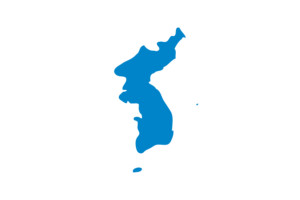 The Korean Unification Flag resembles that of Cyprus in featuring a silhouette of the landmass.
The colour is blue, however, not the Cypriot copper-orange.
The flag first appeared in 1991, when a unified Korean team used it at the World Table Tennis Championship and FIFA World Youth (Under-20) Championship.
Despite competing as separate nations, the two Koreas also marched together under this flag during the opening ceremonies of the Sydney and Athens Summer Olympics (2000 & 2004), Turin Winter Olympics (2006) and Doha Asian Games (2006).
Away from sport, the flag prominently on the border in 2007, when South Korean President Roh Moo-hyun visited the North.
Citizens and officials from North Korea waved it in 2010 and 2012 respectively, when Revd Han Sang-ryol and Ro Su Hui (vice-chairman of the Reunification of the Fatherland Union) returned to the South across the Korean Demilitarized Zone.
Both men faced arrest upon their return for their unauthorized visits.
Bonus fact: Jeju-do Province, the island southwest of South Korea, was part of the original design. Ulleung-do, an island east of South Korea, was only added in 2006.
Author: Alex Crouch, accredited Flag Institute journalist

[…] with athletes from across the island and the two Korean Olympic teams marching together under the Korean unification flag at multiple athletic […]