Saturday 21 March 2015 marks 25 years since Namibia gained its independence from South Africa and officially adopted its national flag.
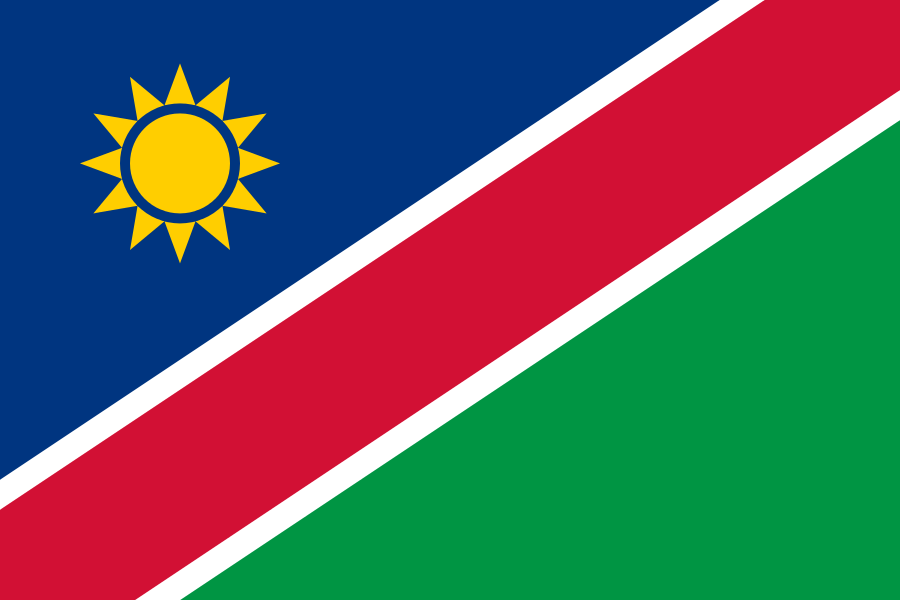 Chosen from 835 publicly submitted designs, the origins of the flags lie in those of the South West Africa People’s Organisation (SWAPO) and the Democratic Turnhalle Alliance (DTA).
Naturally, each colour represents a key aspect of Namibia.
The red band represents its people, their heroism and their determination to build equal opportunities for all.
The flanking white stripes reference peace, while the green represents Namibia’s vegetation and agriculture.
The blue symbolises the sky, the Atlantic Ocean and Namibian water resources and rain.
Within the blue segment lies a 12-pointed star (the Sun) signifying energy and life.
The Chairman of the National Symbols Sub-committee published all the above descriptions on 2 February 1990.
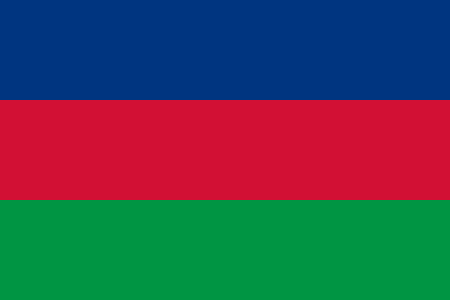
The flag of SWAPO; blue, red and green are the colours most important to the Ovambo, Namibia’s largest ethnic group.
Bonus fact: from 1884 to 1915, Namibia was known as German South-West Africa.
From the First World War until independence, it came under South African control as South-West Africa.

The DTA logo gave the Namibia flag its diagonal band
Author: Alex Crouch, Flag Institute accredited journalist (2015/16).